JillLebofsky may earn a commission if you buy through links on this page, at no extra cost to you. That does not change what we report.
Part of our Synadentix overview. Last checked October 28, 2026.
Does Synadentix work? Nobody can say yet, because we found no study of the Synadentix tablet itself. Its 10 named actives share one 400 mg proprietary blend with no individual doses[2]. The best swallowed-tablet trial of any of them, in 150 adults, needed 60 mg of lactoferrin plus 7.8 mg of lactoperoxidase a day to beat placebo on gum inflammation[4], and its lower dose did not.
Does Synadentix work? The short answer
There is no direct evidence that Synadentix works as sold. The vendor says it is "specifically formulated to rebuild the oral microbiome" and its contact FAQ says it works by "strengthening teeth"[3]. We found no trial of this product for either claim.
What exists is research on the separate ingredients. Hydroxyapatite has solid toothpaste data. Lactoferrin and lactoperoxidase have small trials of sucked tablets. Lysozyme, glucose oxidase, dextranase, amylase, amyloglucosidase and beta-glucanase have mostly toothpaste, lozenge or lab work. Guava was tested as 200 g of fresh fruit a day.
Since the label hides each amount, you cannot tell whether a tablet holds a studied dose. The fair reading is "plausible ingredients, unknown doses, untested product."
Which evidence levels should you not confuse?
Four kinds of evidence get blended together in supplement marketing. Only the last two can tell you whether a product works.
1. Plausibility
Lab and animal work shows a mechanism. Dextranase strips plaque biofilm in lab models, and guava leaf compounds block a tooth-decay enzyme in culture. Mechanisms suggest a reason to test, nothing more.
2. Ingredient trials
Human trials of one ingredient, often in another form. Hydroxyapatite toothpaste is the clearest case: a meta-analysis found about 17% caries protection[6], and an 18-month trial in 189 adults found it non-inferior to fluoride toothpaste[7]. That tells you about brushing with it, not swallowing it.
3. Finished-product trial
A trial of Synadentix itself, at its own dose and directions. None was found, and the vendor's references page cites ingredient studies, not a product study[2].
4. Replication
A second independent trial with the same result. For the swallowed lactoferrin and lactoperoxidase tablets, the trials measured different outcomes, so even that best match is not replicated.
Synadentix claims vs what the evidence supports
The vendor's claims go well past the ingredient data. This table sets each one against what studies measured.
| Vendor claim | Reasonable reading | Limitation |
|---|---|---|
| "Rebuild the oral microbiome"[1] | Lactoferrin plus lactoperoxidase tablets lowered tongue and plaque bacteria in 46 older adults over 8 weeks[5] | Bacterial counts, not gum disease; dose in Synadentix unknown |
| "Strengthening teeth"[3] | Hydroxyapatite toothpaste protects against caries about as well as fluoride toothpaste[7] | Toothpaste used twice daily for months; no swallowed tablet trial |
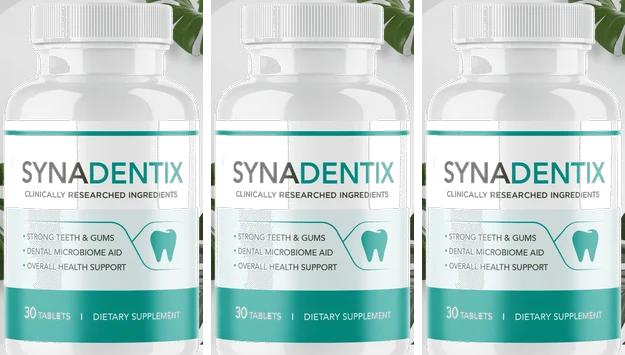
| Stronger gums (implied by "Strong Teeth & Gums" on the label) | 60 mg lactoferrin plus 7.8 mg lactoperoxidase a day lowered gingival index over 12 weeks[4] | The 20 mg dose did not beat placebo |
| "Protects your brain", detoxes "your entire system"[1] | No support found | No study of any blend ingredient measured this |
| "A perfectly dosed proprietary mix"[1] | Cannot be checked | No individual dose is disclosed |
If you want to try it anyway with those limits in mind, the vendor's refund window is 90 days from delivery.
Which ingredients matter most?
Three ingredients carry most of the evidence, and all three have a dose or form mismatch with Synadentix.
- Lactoferrin and lactoperoxidase. The only swallowed-tablet trials. A positive result needed 60 mg and 7.8 mg a day[4]. An even split of the blend gives about 40 mg of each, and the real split is unknown.
- Hydroxyapatite. Strong as toothpaste. Chewing gum with hydroxyapatite, 6 pieces a day for 2 weeks, eased dentin sensitivity[8], but gum stays in the mouth for minutes, while the label says to hold the tablet 30 seconds.
- Guava. The positive trial fed people 200 g of fresh fruit a day[9], about 5,000 times a 40 mg share of powder.
The rest are weaker. With lysozyme toothpaste, mouth ulcers cleared in 5.7 vs 7.5 days in 71 adults[10]. An enzyme toothpaste with glucose oxidase and amyloglucosidase showed no difference from fluoride or plain toothpaste over 3 months[11]. A review called dextranase rinses and gums of "limited clinical success"[12]. A lozenge with beta-glucanase and two other enzymes cut plaque slightly at one dose on day 7, with no gum benefit[14]. Our Synadentix oral support page covers each one.
What results are realistic to expect?
Only what the closest trials measured. In the 12-week tablet trial, the higher lactoferrin and lactoperoxidase dose lowered gingival index scores, a measure of gum redness and bleeding, compared with placebo[4]. In the 8-week trial, bacteria counts on the tongue and in plaque fell[5].
No trial measured rebuilt enamel, closed cavities or fresher breath from a swallowed tablet. Xylitol, the sweetener, has low-quality evidence for fewer cavities when used in toothpaste[13]. The vendor itself says results take "around 9-12 weeks"[3]. Keep brushing with fluoride toothpaste either way.
When should you see a doctor instead?
A supplement is the wrong first step when your mouth shows signs of disease. See a dentist or doctor right away if:
- your gums bleed every time you brush, or are swollen, red or receding
- a tooth is loose, cracked, or hurts when you bite or drink something cold
- you have facial or jaw swelling, fever, or pus near a tooth
- bad breath does not go away with brushing, flossing and cleaning your tongue
- a sore, white or red patch in your mouth lasts longer than two weeks
These can signal gum disease, infection or other problems that need an exam. Our Synadentix safety and legitimacy checks list who the label says should ask a physician first.
Evidence conclusion
| Decision question | Current assessment |
|---|---|
| Has Synadentix itself been tested? | No product trial found |
| Are the ingredients reasonable for oral care? | Yes, most appear in oral-care products |
| Can you tell if the doses match studies? | No, all 10 are hidden in one 400 mg blend |
| Does the delivery form match studies? | Mostly no: toothpaste, rinse and lab work |
| Does it replace brushing or dental visits? | No |
The answer is plausible ingredients and an untested product. If you try it, follow the label and keep your dental routine.
Back to the Synadentix overview.
Frequently asked questions
Does Synadentix really work for teeth and gums?
No study has tested Synadentix itself. The closest evidence is a 12-week trial where tablets with 60 mg lactoferrin and 7.8 mg lactoperoxidase a day lowered gum inflammation scores. Synadentix does not show how much of either it contains.
How long does Synadentix take to work?
The vendor says results take around 9 to 12 weeks. The ingredient trials that found any change ran 8 to 12 weeks for swallowed tablets. No trial of Synadentix itself sets a timeline, so read the vendor figure as a claim.
Can Synadentix replace brushing or fluoride toothpaste?
No. The strongest tooth data for its ingredients come from brushing with hydroxyapatite toothpaste, not from a swallowed tablet. Keep brushing twice a day, flossing and seeing a dentist, and count any supplement as an extra.
Is there a clinical study on Synadentix?
We found none. The vendor references page lists ingredient studies, mostly on toothpaste, topical or lab use, plus xylitol research. None of those tested the Synadentix tablet, its dose or its directions.
What is the strongest ingredient in Synadentix?
Hydroxyapatite has the strongest research, but as a toothpaste. For a swallowed tablet, lactoferrin with lactoperoxidase has the best match, from small trials at 60 mg and 7.8 mg a day. The Synadentix label hides both amounts.
Sources
- Synadentix sales page. Synadentix vendor site, read October 28, 2026.
- References and Supplement Facts label. Synadentix vendor site, read October 28, 2026.
- Contact Us and FAQ. Synadentix vendor site, read October 28, 2026.
- Lactoferrin and lactoperoxidase tablets and gingival index, 12-week randomized trial in 150 adults (PMID 31292969). PubMed, read October 28, 2026.
- Lactoferrin and lactoperoxidase tablets and oral bacteria in older adults, randomized trial (PMID 27150460). PubMed, read October 28, 2026.
- Hydroxyapatite oral care and caries, meta-analysis (PMID 34925515). PubMed, read October 28, 2026.
- Hydroxyapatite vs fluoride toothpaste in adults, 18-month randomized trial (PMID 37533523). PubMed, read October 28, 2026.
- Hydroxyapatite chewing gum and dentin sensitivity, randomized trial (PMID 25122980). PubMed, read October 28, 2026.
- Guava fruit intake in experimental gingivitis, randomized trial (PMID 29757462). PubMed, read October 28, 2026.
- Lysozyme toothpaste and recurrent mouth ulcers, randomized trial (PMID 29178716). PubMed, read October 28, 2026.
- Enzyme toothpaste vs fluoride toothpaste in orthodontic patients, randomized trial (PMID 31242669). PubMed, read October 28, 2026.
- Review of plaque-degrading enzymes including dextranase (PMID 7012186). PubMed, read October 28, 2026.
- Xylitol-containing products for preventing dental caries in children and adults. Cochrane Database of Systematic Reviews, via PubMed, read October 28, 2026.
- Multi-enzyme lozenge with beta-glucanase and plaque, randomized trial (PMID 40676928). PubMed, read October 28, 2026.
This page is general information, not medical advice. Dietary supplements are not reviewed by the FDA for safety or effectiveness before they are sold and are not intended to diagnose, treat, cure or prevent any disease. Talk to your doctor before taking any supplement, especially if you are pregnant, nursing, take medication or have a health condition.