JillLebofsky may earn a commission if you buy through links on this page, at no extra cost to you. That does not change what we report.
Part of our Synadentix overview. Last checked October 28, 2026.
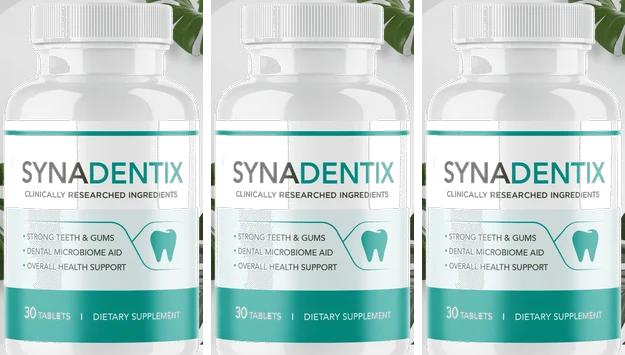
Synadentix oral support is a soft chewable tablet sold for "Strong Teeth & Gums" and as a "Dental Microbiome Aid", with 10 named actives packed into one 400 mg proprietary blend[2]. Split evenly, that is about 40 mg each, and the real split is unknown. We checked every ingredient against published human research on October 28, 2026.
What is in the Synadentix oral support formula?
The formula is a mix of tooth minerals, milk and egg proteins, enzymes and guava. The label lists guava fruit powder, microcrystalline hydroxyapatite, lactoferrin, lysozyme, lactoperoxidase, glucose oxidase, dextranase, amylase, amyloglucosidase and beta-glucanase, plus xylitol as a sweetener[2].
Many of these appear in oral-care products. Hydroxyapatite is a toothpaste mineral, and lactoferrin, lysozyme, lactoperoxidase and glucose oxidase are salivary-type proteins used in dry-mouth gels and enzyme toothpastes.
The vendor calls the blend "a perfectly dosed proprietary mix"[1], but no individual amount, enzyme activity or xylitol quantity is printed. That gap is the main problem in judging it.
What does the ingredient evidence show?
The research is real but mostly in other delivery forms. Only lactoferrin and lactoperoxidase have trials as a swallowed or sucked tablet. This table sums up each active, checked October 28, 2026.
| Ingredient | How it was studied | Main human finding | Our grade |
|---|---|---|---|
| Hydroxyapatite | Toothpaste; chewing gum | About 17% caries protection in a meta-analysis[4]; gum eased dentin sensitivity in 2 weeks[5] | Moderate as toothpaste, weak as a tablet |
| Lactoferrin | Sucked tablets with lactoperoxidase | 60 mg a day lowered gingival index over 12 weeks; 20 mg did not[6] | Limited |
| Lactoperoxidase | Tablets with lactoferrin; lozenge | Lozenge cut plaque regrowth over 4 days, less than a Listerine rinse[7] | Limited |
| Lysozyme | Toothpaste | Mouth ulcers cleared in 5.7 vs 7.5 days, 71 adults[8] | Weak |
| Glucose oxidase | Toothpaste | No difference vs placebo toothpaste for mouth ulcers[9] | Weak |
| Amyloglucosidase | Toothpaste with glucose oxidase | Same null toothpaste trials[9] | Weak |
| Dextranase | 1970s rinses and gum | "Limited clinical success" with side effects, per review[10] | Weak |
| Beta-glucanase | Multi-enzyme lozenge | Slightly less plaque on day 7 at one dose, no gum benefit[11] | Weak |
| Amylase | Lab only for teeth | Can help plaque bacteria get sugar from starch[12] | Weak |
| Guava fruit powder | 200 g fresh fruit a day; leaf rinse | Less plaque and gum inflammation on 200 g fruit[13]; leaf rinse improved gum scores[14] | Weak |
The best match has a dose problem
The strongest swallowed-tablet result came from 150 adults taking 60 mg lactoferrin and 7.8 mg lactoperoxidase a day[6]. If Synadentix splits its blend evenly, a tablet holds about 40 mg of lactoferrin. Two tablets a day might reach 60 mg, or might not. The label does not let you check.
Several ingredients may not help teeth at all
Amylase breaks starch into sugars, and lab reviews show salivary amylase can help plaque bacteria feed[12]. Guava was tested as 200 g of fruit, about 5,000 times a 40 mg share[13], and the guava rinse used leaf, not fruit[14].
Hydroxyapatite works on the tooth surface
Hydroxyapatite is the mineral that makes up most of tooth enamel, which is why it shows up in fluoride-free toothpaste. In those products it sits on the teeth twice a day for months. Swallowed hydroxyapatite has only been tested as a calcium source for bone, at 1 g of calcium a day, not for teeth.
The sales page calls it "NASA-grade Microcrystalline Hydroxyapatite Complex"[1]. The label does not use that phrase, and it gives no particle size or amount.
What the vendor's own references cover
The references page cites studies on hydroxyapatite toothpaste, lactoferrin and periodontitis, industrial uses of glucose oxidase, and xylitol[2]. Those are mostly toothpaste, topical or lab studies. None tested this tablet or its directions, and no product trial is listed.
Allergy and safety notes
Lactoferrin and lactoperoxidase are usually milk-derived, and lysozyme is usually from egg; in one challenge, 5 of 21 egg-sensitized children reacted to lysozyme-containing cheese[15]. Glucose oxidase shares sequence similarity with an almond allergen[16]. Synadentix does not state any source. Xylitol is toxic to dogs, and a 2024 study tied a xylitol drink to higher platelet reactivity[17], so people on blood thinners should ask a doctor.
For how these findings stack up against the vendor's claims, read does Synadentix work.
What should you check before buying Synadentix oral support?
- Milk, egg or almond allergy. Ask your doctor first; ingredient sources are not stated.
- Blood thinners or clotting risk. Ask about the xylitol content, which is also not stated.
- Pregnancy, nursing, under 18 or a medical condition. The label says to consult a physician[2], even though the contact FAQ says it suits "all ages and medical conditions"[3].
- Directions. Follow the label: 1 to 2 tablets a day after brushing, held 30 seconds, then swallowed. See Synadentix chewable directions for the conflicting versions.
- Cost per month. 2 bottles cost $158, checked October 28, 2026, and last 30 days at 2 tablets a day.
- Dental symptoms. Bleeding gums, loose teeth, swelling or pain need a dentist, not a supplement.
Our take
Synadentix oral support uses ingredients with a real place in oral care, especially hydroxyapatite and lactoferrin. The catch is that most of that evidence comes from toothpaste, rinses or lab work, and every dose is hidden in one 400 mg blend.
No study of Synadentix itself was found, so any benefit from the tablet is a guess built on other formats and unknown doses.
A hydroxyapatite or fluoride toothpaste puts the best-studied ingredient straight on your teeth. If you still want the tablet, the 90-day refund counts from delivery, and you pay to post the bottles back. Our Synadentix complaints page lists the refund steps and where to raise a problem.
Back to the Synadentix overview.
Frequently asked questions
What are the ingredients in Synadentix?
The label lists guava fruit powder, microcrystalline hydroxyapatite, lactoferrin, lysozyme, lactoperoxidase, glucose oxidase, dextranase, amylase, amyloglucosidase and beta-glucanase in one 400 mg blend, plus xylitol, microcrystalline cellulose, magnesium stearate and natural flavoring.
How much lactoferrin is in Synadentix?
The label does not say. Lactoferrin is one of 10 actives in a 400 mg blend, about 40 mg if split evenly. The tablet trial that found a gum benefit used 60 mg lactoferrin with 7.8 mg lactoperoxidase a day.
Is Synadentix advanced oral support a probiotic?
No. The label lists no bacterial strains. It contains hydroxyapatite, milk and egg type proteins, five enzymes, guava fruit powder and xylitol. The vendor says it rebuilds the oral microbiome, but no study of the tablet tested that.
Does Synadentix contain milk or egg?
The label does not state sources. Lactoferrin and lactoperoxidase are usually made from milk and lysozyme usually from egg, so people with milk or egg allergy should ask a doctor or the vendor before taking it.
Is hydroxyapatite in a tablet as good as hydroxyapatite toothpaste?
There is no trial showing it is. Hydroxyapatite toothpaste matched fluoride toothpaste for caries in an 18-month adult trial, but swallowed hydroxyapatite has only been studied as a calcium source for bone, not for teeth.
Sources
- Synadentix sales page. Synadentix vendor site, read October 28, 2026.
- References and Supplement Facts label. Synadentix vendor site, read October 28, 2026.
- Contact Us and FAQ. Synadentix vendor site, read October 28, 2026.
- Hydroxyapatite oral care and caries, meta-analysis (PMID 34925515). PubMed, read October 28, 2026.
- Hydroxyapatite chewing gum and dentin sensitivity, randomized trial (PMID 25122980). PubMed, read October 28, 2026.
- Lactoferrin and lactoperoxidase tablets and gingival index, 12-week randomized trial in 150 adults (PMID 31292969). PubMed, read October 28, 2026.
- Lactoperoxidase system lozenge and plaque regrowth, crossover trial (PMID 34732139). PubMed, read October 28, 2026.
- Lysozyme toothpaste and recurrent mouth ulcers, randomized trial (PMID 29178716). PubMed, read October 28, 2026.
- Enzyme toothpaste with amyloglucosidase and glucose oxidase in recurrent mouth ulcers (PMID 11885246). PubMed, read October 28, 2026.
- Review of plaque-degrading enzymes including dextranase (PMID 7012186). PubMed, read October 28, 2026.
- Multi-enzyme lozenge with beta-glucanase and plaque, randomized trial (PMID 40676928). PubMed, read October 28, 2026.
- Salivary amylase and oral bacteria, review (PMID 8373987). PubMed, read October 28, 2026.
- Guava fruit intake in experimental gingivitis, randomized trial (PMID 29757462). PubMed, read October 28, 2026.
- Guava leaf mouthrinse in gingivitis, randomized trial (PMID 31752836). PubMed, read October 28, 2026.
- Lysozyme reactions in egg-sensitized children, oral challenge study (PMID 22692502). PubMed, read October 28, 2026.
- Safety evaluation of the food enzyme glucose oxidase, EFSA (PMID 37809354). PubMed, read October 28, 2026.
- Xylitol, platelet reactivity and cardiovascular events (PMID 38842092). PubMed, read October 28, 2026.
This page is general information, not medical advice. Dietary supplements are not reviewed by the FDA for safety or effectiveness before they are sold and are not intended to diagnose, treat, cure or prevent any disease. Talk to your doctor before taking any supplement, especially if you are pregnant, nursing, take medication or have a health condition.